Amirthagateswarar temple, Tiru-Kadavur
Location
Tiru-Kadavur
Deity
Amirthagateswarar
Female Deity
Abirami
Pathikam
Tirunavukarasar - 3, Sambandar - 1, Sundarar - 1
Gallery - Amirthagateswarar Temple
How to Reach
This Shiva temple is situated on the Mayiladuthurai–Tarangambadi route. Tirukkadavur Mayanam, is located about 2 km from here. Tirukkadavur is easily accessible from Sirkazhi as well as Mayiladuthurai.
Temple Address
Thirukkadaiyur
Thirukkadaiyur Post
Mayiladuthurai Taluk
Mayiladuthurai District
PIN – 609311
Temple Hours
Morning : 6:00 - 1:00
Evening : 5:00 - 8:00
Contact
04364 287429
Nearby Paadal Petra Shiva Temples
Nearby Vaipu-Sthalam
Temple Legends
Brahma and the Bilva Seed
According to legend, Brahma, the Creator, longed to attain divine wisdom and therefore undertook intense penance, meditating upon Shiva with unwavering devotion. Pleased by his sincerity, Shiva bestowed upon him a sacred bilva seed and instructed him to worship at the place where the seed would sprout within a muhurtha (48 minutes) of being sown, promising to impart divine knowledge (jnana upadesham) there. Brahma sowed the seed, and it miraculously sprouted within the auspicious period at Thirukkadaiyur. In accordance with Shiva’s command, Brahma worshipped the Lord at this spot and received the desired spiritual wisdom. Owing to this divine event, the sacred place came to be known as Vilva Vanam (the Forest of Bilva Trees).
The Pot of Nectar
According to legend, the Devas, having obtained the sacred Amrita (nectar of immortality) from the churning of the Ocean of Milk, wished to keep it for themselves and carried it away in a pot (kadam). During their journey, they halted at this place to bathe and temporarily set the pot on the ground. However, when they returned and attempted to lift it, they found that it had become firmly rooted and could not be moved. The spot where the pot became established came to be known as Tiru-Kadaiyur. It is believed that the pot subsequently transformed into a Shiva Lingam, and Shiva manifested there as Amritaghateswarar, the Lord of the Nectar Pot, who continues to be worshipped in this temple.
Ashta Veeratta Temple
Tiru-Kadaiyur is one of the 'Ashta Veerattana' temples. Shiva vanquished Yama, the God of Death, here to save the life of Markandeya.
The Legend of Markandeya
Sage Mrikandu and his wife fervently prayed to God Shiva for a child. Shiva appeared before them and offered a choice: they could be blessed with a foolish son who would live a long life, or an intelligent son whose life would be short. The sage and his wife chose the latter. In due course, they were blessed with a brilliant child, who came to be known as Markandeya.
As Markandeya approached his sixteenth year, he learned that his life was destined to end. Undaunted, he left his home and took refuge in a Shiva temple, immersing himself in intense devotion. At the appointed hour, Yama, the god of death, arrived to claim the boy's soul and cast his noose around him. Markandeya instantly embraced the Shiva Lingam, and the noose fell upon the Lingam itself.
Enraged by this act, God Shiva emerged from the Linga and struck Yama down, killing him and thereby halting death itself. Markandeya was thus saved. However, with Yama's death, no living being on earth could die, and Bhumi Devi, the Earth Goddess, found herself unable to bear the ever-increasing burden of life.
Moved by the prayers of the gods and the suffering of the earth, Shiva restored Yama to life (at Tirupaingneeli) and granted Markandeya eternal youth, blessing him to remain forever sixteen.
Divine Significance
Tiru-Kadaiyur is where this legend is believed to have unfolded. The presiding deity here is Amritaghateswarar—the deity associated with the pot of nectar (Amrita), who bestows immortality. This divine episode is vividly portrayed in the form of a bronze idol of Kaala Samhara Moorthy.
Temple Structure
Rajagopuram
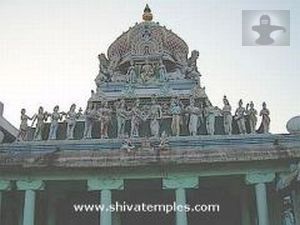
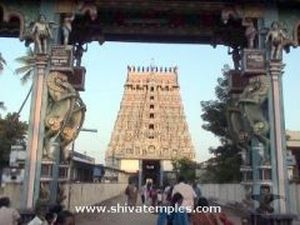
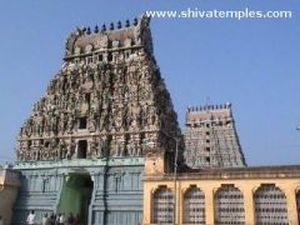
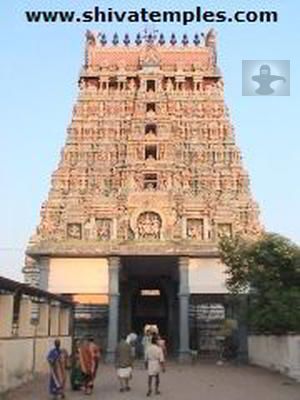
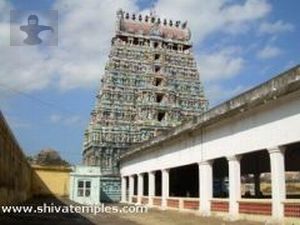
Although the temple has Rajagopurams on both the eastern and western sides, the seven-tiered Rajagopuram on the western side serves as the main entrance. The presiding deity, Amritaghateswarar, enshrined in the sanctum, is a Swayambhu Lingam facing west.
Subsidiary Deities
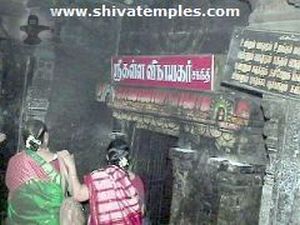
The circumambulatory corridor around the sanctum houses sannidhis for Muruga, Lakshmi, Somaskanda, Nataraja, Vilvaneswarar, Bhairava, the Pancha Bhoota Lingas, Surya, Agastya, the Sapta Kannikas, and the 63 Nayanmars. Notably, there is no Sannidhi for the nine planetary deities (Navagraha) in this temple.
Kaala Samhara Moorthy
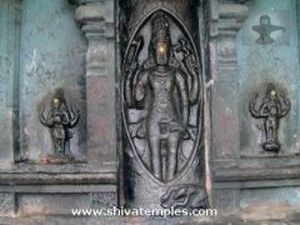
In the mandapam facing the main sanctum, devotees can behold the magnificent bronze image of Kaala Samhara Moorthy, depicting Shiva in the act of subduing Yama, the god of death. In this striking representation, Yama is shown fallen beneath the Deity’s feet, while Kaala Samhara Moorthy stands with His right foot firmly planted on the ground and His left foot raised in the act of striking Yama. Nearby stands Markandeya, the devoted sage, with folded hands, offering reverent worship to the Deity. A separate sannidhi for Yama Dharma Raja is also found within the temple. Here, Yama is portrayed standing with folded hands alongside his buffalo mount. Tradition holds that Yama’s noose came into contact with the Shiva Lingam while attempting to seize Markandeya. The resulting crack on the crown and the marks on the body of the Lingam can still be seen even today, serving as a reminder of this celebrated divine episode.
Goddess Abirami – Abirami Anthathi
Goddess Abirami
The sannidhi of Goddess Abirami is situated in the outer prakaram of the temple and faces east. Revered as the embodiment of divine grace and compassion, Goddess Abirami is believed to have bestowed her blessings upon both Goddess Saraswati and the great devotee Abirami Bhattar.
Legend of Abirami Bhattar
Abirami Bhattar, who lived in this town, was an ardent devotee of Goddess Abirami. So profound was his devotion that he often remained absorbed in contemplation of the Divine Mother, becoming oblivious to the world around him. On one such occasion, when King Serfoji II of Thanjavur visited the temple, he asked the Bhattar to identify the lunar day (tithi). Completely immersed in the thought of Goddess Abirami, Bhattar mistakenly declared the new moon day (Amavasya) to be the full moon day (Pournami). The temple priests, who had already conveyed unfavorable opinions about the Bhattar to the king, used this incident to further discredit him. Angered by what he perceived as deception, the king declared that Bhattar would face severe punishment if the full moon failed to appear that night.
Abirami Anthathi
Placing complete faith in the Goddess, Abirami Bhattar surrendered himself at Her feet and began composing the Abirami Anthathi, a celebrated garland of one hundred devotional verses in Her praise. Moved by the unwavering devotion of Her devotee, Goddess Abirami performed a divine miracle. As Bhattar sang the seventy-ninth verse, the Goddess removed one of Her earrings and cast it into the sky, where it shone brilliantly as a radiant full moon, transforming the night of Amavasya into Pournami.
Realizing the greatness of Abirami Bhattar and the boundless grace of the Divine Mother, the king sought forgiveness. The Abirami Anthathi has since been revered as one of the finest devotional works in Tamil literature. Devotees believe that worshipping Goddess Abirami and reciting these sacred verses with faith brings divine protection, prosperity, peace, and all-round well-being.
Special Features of the Temple
Karthigai Month Somavara Abhishekam
On every Monday (Somavaram) during the Tamil month of Karthigai, a grand abhishekam is performed to the presiding deity using 1,008 sacred conch shells, including rare right-spiralled (Valampuri) conches. The conches are ceremonially arranged in the Shankha Mandapam situated opposite the sanctum. This occasion is especially significant, as it is one of the few times when devotees can behold the deity in an unadorned state. During the ritual, the marks believed to have been left by Yama's noose, along with the crack on the crown of the Lingam—associated with Lord Shiva's emergence to protect Markandeya and subdue Yama—are said to be clearly visible.
Abhishekam for Kaala Samhara Moorthy
The bronze image of Kaala Samhara Moorthy enshrined in the front mandapam is a remarkable work of sacred artistry. It portrays Lord Shiva emerging from a split Shiva Lingam, holding the trident and appearing in the act of vanquishing Yama. Abhishekam for this revered deity is performed only eleven times each year. On these rare and auspicious occasions, devotees are blessed with the opportunity to witness the extraordinary beauty and grandeur of the Lord's divine form.
Shanti Rituals
This sacred temple is traditionally believed to be a place where even the Navagrahas and Yama himself are subject to the supreme authority of Lord Shiva. As a result, devotees hold that sincere worship offered here can help alleviate various afflictions, particularly those connected with longevity, health, and the fear of death.
The temple is renowned for the performance of special Shanti rituals and homams conducted for devotees seeking blessings for long life and well-being. Many visit the shrine to celebrate important milestones such as their 60th, 70th, 80th, and other significant birthdays. Throughout the day, homams and special pujas are performed both within the temple precincts and around the prakaram. Owing to the immense popularity of these ceremonies, advance bookings are often required, making this one of the most sought-after and revered temples in Tamil Nadu.
Significance
While not everyone can attain the unique blessing bestowed upon Markandeya and remain eternally youthful, devotees believe that worshipping Amritaghateswarar grants protection, longevity, and freedom from the fear of death. It is held that the Deity's grace ensures a life of peace and well-being, and that the inevitable journey beyond this world is met with serenity and divine blessings.
Ashta Veeratta Sthalam
The temples where Shiva is believed to have performed his dance of valor are collectively known as the Ashta (Eight) Veeratta Temples. All eight of these temples are located in Tamil Nadu.
Significant temples around Tirukadavur
Ananthamangalam
Situated about 3 km from Thirukkadaiyur, Ananthamangalam is home to the renowned Rajagopala Perumal Temple. The temple is particularly famous for its unique Trinethra Panchamukha Anjaneya (the five-faced Hanuman with three eyes), which attracts numerous devotees.
Thillaiyadi
Thillaiyadi lies about 4 km east of Tiru-Kadaiyur on the road leading to Thiruvidaikazhi. The Shiva temple here is distinguished by its spacious prakaram and imposing rajagopuram. The presiding deity is worshipped in the form of a self-manifested (Swayambhu) Lingam, adding to the sanctity of the shrine.
Thiruvidaikazhi
Located about 3 km west of Thillaiyadi, Thiruvidaikazhi is a celebrated Murugan shrine praised in the sacred Thiruvisaippa hymns. Although the temple's moolavar is Lord Thirukameswarar, the principal deity revered by devotees is Lord Subramanya. The shrine is especially significant as it was glorified by Saint Arunagirinathar in his revered Tiruppugazh hymns.
Devanur
Close to Thillaiyadi lies the village of Devanur, where devotees can visit the temple of Lord Viswanathar and Goddess Visalakshi. Of particular importance is the shrine of Gyana Guru Bhagavan, which is traditionally believed to have been worshipped by Indra, the king of the Devas.
Tharangambadi
About 8 km southeast of Thirukkadaiyur lies Tharangambadi, identified with the Thevara Vaippu Sthalam known as Alappur. The ancient Shiva temple here, dedicated to Lord Masilanathar, has suffered considerable damage over the centuries due to relentless coastal erosion and encroaching sea waves. Tharangambadi also holds special significance in Murugan worship, as it is the place where Lord Muruga of Thiruvidaikazhi is traditionally believed to perform the divine Soorasamharam during the annual Kanda Sashti festival.
Gallery - Amirthagateswarar Temple