Sri Narthanapureeswarar Temple, Tiru-Thalaiyalankadu
Location
Tiru-Thalaiyalankadu
Deity
Sri Narthana-Pureeswarar, Aadal-Valla-Nathar
Female Deity
Sri Balambikai, Tirumadanthai Ammai
Pathikam
Tirunavukkarasar - 1
Narthanapureeswarar Temple Photos
How to Reach
This Shiva temple is located about 8 km to the east of Kudavasal. Tirupperuvelur, another Tevaram Paadal Petra Sthalam, is situated nearby, about 5 km to the east from here.
Temple Address
Thalaiyalangadu
Sembangkudi Post
Kodavasal Taluk
Tiruvarur District
PIN – 612603
Temple Hours
Morning : 8:00 - 10:30
Evening : 5:00 - 7:00
Nearby Paadal Petra Shiva Temples
Temple Significance & History
Temple Legend
The sages of Tharukavana, blinded by pride and arrogance, sought to destroy Shiva through an abhichara Homa, a powerful ritual performed with the intention of causing harm. From the sacred fire emerged a fierce tiger, which Shiva effortlessly subdued. He tore away its skin and wore it as His garment, then began His majestic and awe-inspiring dance. He adorned Himself with serpents, held a deer in one hand and a battle-axe in the other, displaying His divine power and fearlessness. The sages then sent forth Muyalakan, a powerful being, against Him. Shiva subdued Muyalakan and performed His divine dance upon him. Through this magnificent display, Shiva humbled the sages and revealed that all actions in the universe unfold through His divine will. This temple is revered as the place where Shiva performed this divine dance after overcoming Muyalakan, making it a particularly significant shrine for devotees who cherish the glory of His cosmic dance.
Historical Significance
Thalaiyalangadu, praised in the Tevaram hymns, is also well known in the history of South India. During the Sangam period, it was known as “Thalaiyalanganam”. A fierce battle was fought here between the Chera, Chola and Pandya kings, in which the Pandya king Nedunchezhiyan emerged victorious. As a result, he came to be known by the title “Nedunchezhiyan who won the battle at Thalaiyalanganam”. The Purananuru gives a detailed account of this historic battle. Despite the great historical and spiritual significance of this place, the temple itself is situated in a peaceful and serene setting, away from the bustle of everyday life.
Temple Structure
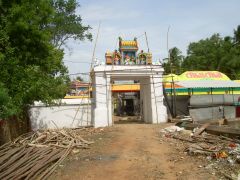
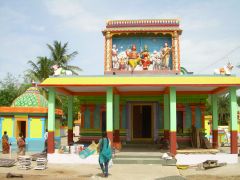
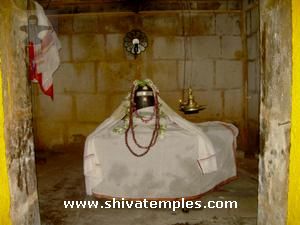
The temple, though modest in appearance, has its own quiet charm, without a towering Rajagopuram or imposing outer walls. Facing east, it has the sacred temple tank, Shangu Theertham, situated directly in front. As one enters through the gateway above the tank bund, the sannidhi of the Goddess, facing south, is seen first. In this separate enclosure with a small front mandapam, Sri Balambikai graces devotees with Her beauty and compassion. She is also known as Thiru Madanthai. A separate sannidhi for Chandikeswari is also found here. Outside the sannidhi, Saneeswarar faces east, while Nandi Devar is seated in a separate mandapam. From here, a long open pathway leads towards the sannidhi of the presiding deity. The main sanctum, built of brick, comprises the Sabha Mandapam, Maha Mandapam and Artha Mandapam. Within the sanctum, Sri Narthanapureeswarar is beautifully enshrined as a Lingam on a square Avudaiyar, with a tall Bana. He is also known by the Tamil name Aada-Vallanathar, meaning “the Lord who excels in divine dance”, a name that beautifully reflects the temple’s association.
Special Shrines & Features
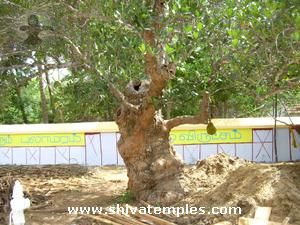
After having darshan of the presiding deity, devotees can circumambulate the temple and offer prayers beneath the jackfruit tree, the temple's sthala vriksham, which stands on the northern side. The prakara also has a separate Lingam and individual sannidhis for the Goddess, Ganesha and Muruga. In front of the main sannidhi is a beautiful idol of Goddess Saraswati holding a palm-leaf manuscript. A unique feature here is that Saraswati is depicted without her veena. According to tradition, when Goddess Saraswati worshipped Shiva at this place, He blessed her with the vision of the Jyotirlinga. Another remarkable feature of the temple can be witnessed during the Tamil months of Panguni and Chithirai. On Panguni 30 and 31, and Chithirai 1, 2 and 3, the rays of the rising Sun fall directly upon the presiding deity, creating a beautiful and auspicious sight for devotees.
Temple Glory & Remedies
The temple tank, known as Sangu Theertham, holds a special place in the spiritual traditions of this temple. It is traditionally believed that bathing in its waters continuously for 45 days, followed by lighting a ghee lamp and offering prayers to the presiding deity and Goddess, can bring relief from various ailments, including skin conditions such as leucoderma. Worship at this place is also believed to help remove ancestral curses. Devotees seeking relief from obstacles are traditionally advised to offer a vada malai to Bhairava, which is believed to help overcome adversaries. Similarly, performing Bilva archana to the presiding deity and Goddess for nine consecutive weeks is believed to remove obstacles and help bring success in long-pending matters. It is also traditionally believed to be beneficial in court cases and to bless devotees with children. Adding to the unique spiritual significance of this temple is its association with Shiva's divine dance. As one of the rare places where Shiva is believed to have performed His divine dance, the temple holds a special significance for those learning or practising the art of dance. For such devotees, offering prayers here is considered particularly auspicious.
Significance of the Pathigam
The Pathigam sung by Thirunavukkarasar (Appar) in praise of this sacred place forms part of the Sixth Thirumurai. Such was Appar’s reverence for the sanctity of this land that he considered it a great sin to set foot upon it. He therefore came here supporting himself with his hands, rather than walking, and worshipped Shiva while singing his Pathigam. It is believed that on the day of Thai Amavasya, Shiva appeared before Appar beneath the jackfruit tree in the northern prakara and blessed him. Appar composed ten verses in praise of Thalaiyalangadu and has also referred to this place in the Pathigams he composed for other temples. Throughout the Thalaiyalangadu Pathigam, Appar expresses deep remorse that he had allowed his precious days to pass without attaining the Deity of Thalaiyalangadu. His heartfelt verses reflect both his profound devotion and his intense longing for the grace of Shiva.
Narthanapureeswarar Temple Photos